


Looking back at the 2025 holiday season, the traditional first quarter debt recovery challenge has once again materialised. The December spending spree predictably led to reduced collection and recovery yields in early 2026. With consumers still dealing with their holiday debt hangovers, optimal strategies and operational execution remain crucial to mitigating these post-festive impacts.
As we move through February 2026, South Africa continues to face challenging economic circumstances, as illustrated by current market conditions:
- The household debt-to-income ratio stands at approximately 62.5%,
- Consumer credit extension in SA totals approximately R 2.6 trillion, with around 8% of this debt past due, and
- Approximately 36% of the 28.9 million credit-active consumers have impaired credit records.
Credit providers are also navigating evolving regulatory frameworks that continue to make delinquent account management increasingly complex, particularly where debt is unsecured and clients have multiple exposures across various credit providers.
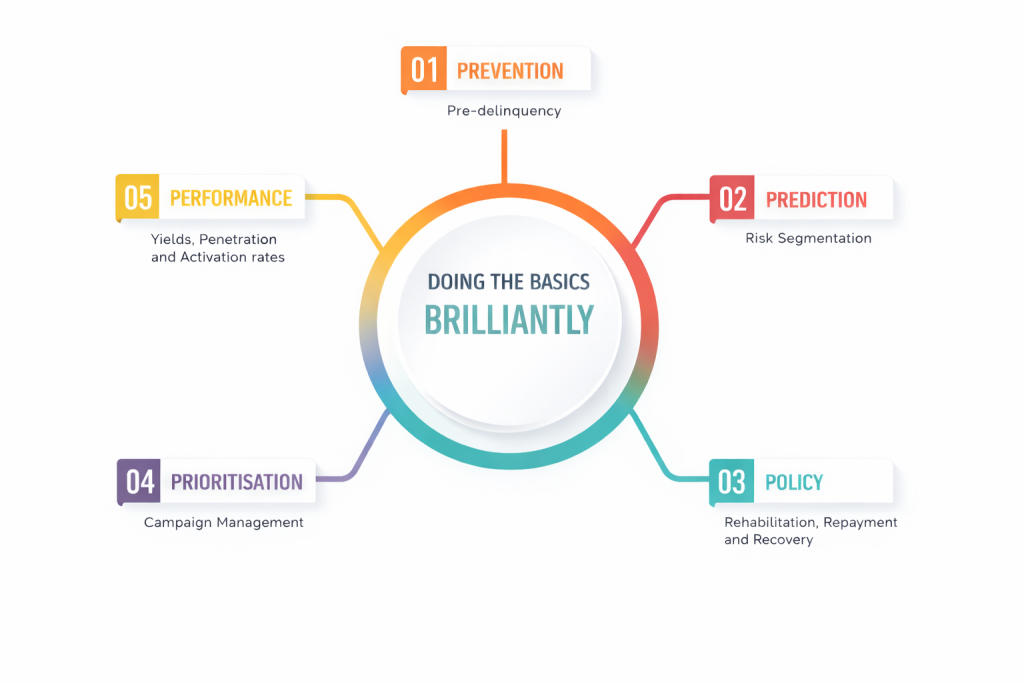
As we work through this post-holiday recovery period, there remains no silver bullet to curing the collections headache. However, superior yields require credit providers to ensure synergy between key, distinct collection and recovery disciplines that span strategy, people, process, and technology. The best remedy continues to be doing the “basics brilliantly.”
Doing Basics Brilliantly
1. Prevention
An ounce of prevention is better than a pound of cure. It’s always better to focus on limiting the likelihood that current clients will roll into a delinquent state. The key to doing this successfully is to segment your debtors by how likely they are to pay or roll into delinquency in the coming months, and then treat each segment accordingly. Remember, these clients have not defaulted — the point is to reach them with the relevant treatment before they do.
The most effective approach is to develop a propensity-to-roll scorecard derived from a combination of internal (payment history, account maturity, etc.) and external (bureau) data. This divides your current portfolio into distinct high-, medium-, and low-propensity-to-roll categories.
Next, prioritise your high-propensity-to-roll population segment using a suitable treatment framework (call, SMS, or other channels) and remind them of the importance of maintaining their current credit standing. The primary treatment here should be educational.
2. Prediction
‘Knowledge,’ as they say, ‘is power.’ Superior credit providers and debt collectors should be able to segment their delinquent account holders into clear categories based on their ability to pay. This ability to understand and predict who is most likely to fail to meet their obligations in the short term is underwritten by analytically derived propensity-to-roll scorecards.
As per the preventative steps above, these perspectives are sourced from a combination of internal and external data; the latter primarily derived from credit bureau information. While other data sources may indicate a propensity to roll (or cure), such as social media or mobile data, their veracity has yet to be fully established.
Segmenting a portfolio into discrete risk segments allows for optimising workforce management, campaign prioritisation, and suitable treatment frameworks to address real (and perceived) risk and align effort (and, by implication, cost) with an acceptable collection or recovery outcome.
3. Policy
Another effective way to improve collection rates is to create a holistic policy framework that offers both the credit provider and the debtor sensible, workable opportunities to regularise and/or exit delinquent debt on a ‘win-win’ basis.
There is an old adage in credit that states: “Your first loss is often your best loss,” and forward roll-rate statistics seem to confirm that, unless an exposure is contained within 60 days of becoming delinquent, there is a high probability that the account will eventually roll into a state of write-off.
Part of the lost opportunity here is that some credit providers have not considered when to rehabilitate, when to seek repayment, and ultimately, when to institute recovery proceedings in a logical, sequentially driven policy framework. ‘Doing the same thing and expecting different results’ is a well-known definition of insanity, yet how many debtors receive differentiated, tilted collection and recovery treatments as they progress along the delinquent credit lifecycle? By tilted, we mean the (1) type of collection action, (2) the tone of collection action, and ultimately (3) the timing of the collection or recovery action.
Therefore, the key to an optimal policy framework is articulating the following three treatment frameworks:
- When to rehabilitate (and what to offer to the debtor to support the philosophy),
- When to seek a mutually beneficial (and commercially astute) exit by way of compromise/settlement, and finally,
- When to consider commercially sound debt recovery proceedings.
Underpinning all of this are the credit provider brand values, the regulatory environment, and ultimately, the defined reputation risk framework within which a credit provider wishes to navigate.
4. Prioritisation
Having identified who may or may not pay you, and articulated a policy framework that allows the credit provider to apply differentiated, tilted treatments to specific risk segments, the next ‘basic that needs to be executed brilliantly’ is how to operationally deploy this strategy to ensure adequate portfolio penetration and activation rates.
This component is arguably the most challenging to execute and is probably one of the prime drivers for misalignment between risk and operations. Given that there are so many moving parts — capacity management (now more frequently referred to as workforce management), contactability, agent productivity, and dialler optimisation to name but a few — this execution component requires a carefully considered approach to maximise portfolio yields.
In this space, one needs clearly articulated collection and recovery calendars that specify:
- What campaigns are run and when they are retired,
- What treatments are executed (sometimes in parallel),
- The optimum time to call,
- When to retire accounts from the dialler campaigns and escalate trace activities,
- A good combination of predictive and preview dialler campaigns,
- Alignment between capacity and likelihood of debtor engagement (you don’t want redundant agents and idle dialler time) and ultimately,
- The capability of monitoring productivity and granular dialler campaign outcomes to ensure appropriate mitigation of risk inherent in the portfolio.
There are several software models that can facilitate and enhance this process by calculating the required productivity and performance outcomes to support given collection targets. These models extract salient operational data to provide insights and validate real-time decision-making.
5. Performance Monitoring
Finally, if one considers the extent of actual collection and recovery activities and outcomes that occur in a real-time environment for a mid- to large-scale credit provider, then it is a business-critical requirement to have superior insights at a strategic, financial, and tactical level.
This business intelligence is drawn from a variety of platforms (host, dialler, and collection/recovery systems) and should be able to tell a compelling story in terms of the following key metrics (not exhaustive):
- Portfolio yields and collection/recovery rates per propensity-to-roll or pay segment,
- Transition matrices to track movement of delinquent balances,
- Granular campaign outcomes — the relationship between attempts/connects/right parties and promise-to-pay outcomes,
- Granular campaign penetration — extent of accounts worked and activation (payment) rates,
- Productivity and capacity management by way of operational insights in terms of accounts worked/not paid; accounts worked/paid; accounts not worked/not paid, and accounts not worked/paid,
- Underlying costs to collect and recover,
- Debit Order tracking and outcomes, and
- Compromise/settlement performance.
There are many other important metrics, but broadly speaking, if there is adequate coverage in terms of the above, then there should be a good understanding of ’cause’ and ‘effect.’
Getting through the over-indulgence of holiday shopping with minimal headaches
In summary, as we navigate February 2026 and the aftermath of the holiday spending season, the ability to optimise collection and recovery outcomes rests on these five key pillars synthesised through these themes:
This is not to say that other components, such as performance management, practitioner management, and regulatory management, are not fundamental to the success of any credit provider navigating the increasingly precarious South African debt enforcement process. However, get these disciplines right, and you are well on your way to recovering from the “over-indulgence” that came with the 2025 holiday shopping season and positioning your collections for success throughout 2026.
Ready to Optimise Your Debt Recovery Strategy?
At Principa, we specialise in helping credit providers navigate the complexities of debt collection and recovery through data-driven insights and strategic solutions. Our team of experts combines advanced analytics with deep industry knowledge to help you implement the five pillars outlined above and achieve superior collection yields.
Whether you’re looking to develop propensity-to-roll scorecards, optimise your workforce management, or create a comprehensive policy framework, we’re here to help you do the basics brilliantly.
Learn more about Principa and discover how our tailored solutions can transform your collections performance in 2026 and beyond.